
Gauteng's Summer Storms: Essential Care for Pots and Water Features
Gauteng's summer storms can rot container plants and burn out water-feature pumps. How to clear drainage, water deeply and keep pumps covered.
By Kainos · · 5 min read
Late November on the Highveld means the afternoon storm season has arrived. Mornings start clear and hot, often pushing past 30°C by midday. Then the sky bruises purple over the Magaliesberg, and the rain comes down hard enough to fill a pot in minutes. For gardeners in Centurion, Pretoria East, Midrand, and across Johannesburg, this month brings the worst punishment of the year for concrete pots and water features. The same downpour that revives a parched lawn can rot the roots of a container plant. The evaporation that follows can expose a pump and burn it out before you notice the water level has dropped.
Check your pot drainage before the next storm
Concrete pots from our factory in Celtisdal are built to outlive their owners, but they cannot save a plant from sitting in water. Highveld thunderstorms can drop a lot of rain in a short burst from now through March, and any blocked drainage hole becomes a death trap.
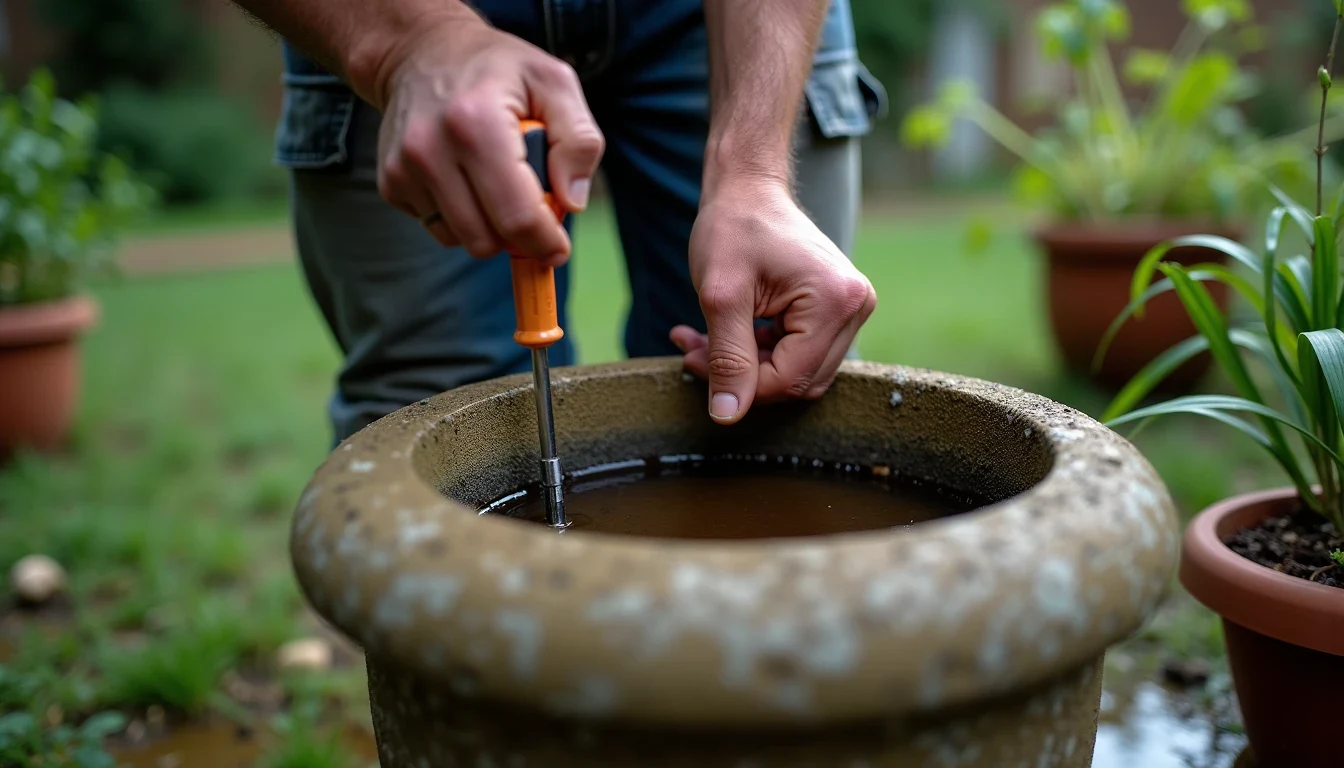
Start by turning the pot or peering underneath. Probe each drainage hole with a skewer or old screwdriver to clear compacted soil, roots, or grit washed in during heavy rain. If the pot sits flat on paving or a saucer, lift it onto pot feet, bricks, or broken tiles. That air gap underneath lets water escape instead of pooling back up through the hole. We see this constantly on deliveries in Pretoria East and Midrand: a beautiful pot, a dead plant, and a drainage hole sealed against the concrete slab by its own weight.
If water still sits on the surface half an hour after the rain stops, your potting mix has broken down. Garden soil in a container turns to sludge; you need a proper container mix with perlite, bark chips, or coarse sand. For a badly waterlogged specimen, knock it out, trim any blackened roots, and repot with a layer of gravel or broken crocks at the base before adding fresh mix.
Water deep and mulch thick for the heat between storms
The gap between afternoon storms can stretch to five or six days. In that heat, a large pot can dry to the core. Shallow watering trains roots to stay near the surface where they fry. Deep watering, done early, forces them down where the soil stays cooler and damper longer.
Water before 9 am, slowly enough that the moisture soaks through rather than running off the baked surface. For a big pot in full sun, this might mean ten or fifteen minutes with the hose on a trickle, pausing to let it absorb. Check by pushing a finger five to seven centimetres into the mix; if it comes out dry, the plant needs more.
Then cover the surface with three to five centimetres of organic mulch. Bark chips, macadamia shells, or compost all work. Keep the mulch clear of the stem itself to avoid rot. A proper layer noticeably slows evaporation, which helps when Rand Water is watching consumption and your rosemary is trying to survive a 35°C afternoon in a pot on a Bryanston patio.
Choose plants that can take the afternoon hammering
The Highveld’s western sun is not gentle. UV indices hit extreme through December and January, so a pot in full afternoon exposure needs plants built for it.
Indigenous succulents are the obvious survivors. Portulacaria afra, Spekboom, handles full sun and neglect and still pulls carbon from the air. Aloes of all sizes, from Aloe ferox down to compact hybrids, give structure and winter flower colour. For something softer, Dietes grandiflora (Wild Iris) and Gaura lindheimeri hold up well. Mediterranean herbs like lavender and rosemary thrive once their roots are established. Indigenous grasses add movement; Natal Red Top (Melinis repens) and Themeda triandra (Red Grass) both take the heat without complaint. Skip Fountain Grass (Pennisetum setaceum): it is a listed invasive in South Africa.
Avoid anything with thin, dark leaves that scorch easily, and anything that needs steady moisture unless you are prepared to water daily through January.
Top up water features and guard the pump
A submersible pump is cooled by the water around it. If the level drops to expose the intake, the motor overheats, seizes, and dies. A replacement pump costs far more than the minute it takes to check the level, and the damage is entirely preventable.
Check the feature daily through the hot weeks. Evaporation accelerates dramatically after a storm front passes and the dry heat returns. Top up slowly with a hose until the pump sits under at least five to ten centimetres of water. For larger features, an automatic float valve connected to the mains removes the risk entirely and pays for itself the first time it saves a pump.
Shade helps too. Position the feature where afternoon trees or tall grasses cut the worst of the sun, or plant around it to create natural shelter. Less direct heat means less evaporation and less thermal stress on the pump housing.
Stop mosquitoes and algae from colonising
Stagnant water after a storm is an invitation. Mosquitoes need still surface water to breed, and the Highveld’s warm nights let them cycle fast from late November through March.
Keep the pump running through daylight hours, or continuously if the feature is in a sheltered courtyard where mosquitoes gather. The surface disruption stops larvae from developing. Do not stock mosquito fish (Gambusia): they are a listed invasive under NEMBA. After heavy rain, walk the garden and empty any saucers, tarp folds, or container lids that have collected water. A pot saucer left full is as dangerous as a neglected pond.
Algae blooms on sunlight and nutrients. Cover fifty to seventy percent of the surface with water lilies or other floating plants to cut the light reaching the water. Upgrade filtration if the water stays green, and scoop visible algae with a net before it clogs the pump intake. Partial water changes of a quarter to half the volume help reset nutrient levels without destroying the balance of a healthy feature.
This week in your garden
- Lift every concrete pot and check drainage holes are clear; raise any sitting flat onto feet or bricks
- Water large pots deeply before 9 am on non-rain mornings; apply fresh mulch where it has thinned
- Walk water features daily and top up before the pump intake breaks the surface
- Empty all standing water from saucers, trays, and garden debris after the next storm
- Move or shade any pot with scorched leaves; consider replacing with Spekboom, aloe, or rosemary if the location gets brutal afternoon sun
 Gardening
 Gardening
 Gardening